

Here's the pitch...Part One
Part One - A look at the evolution of pitching from the 1830's until 1900!

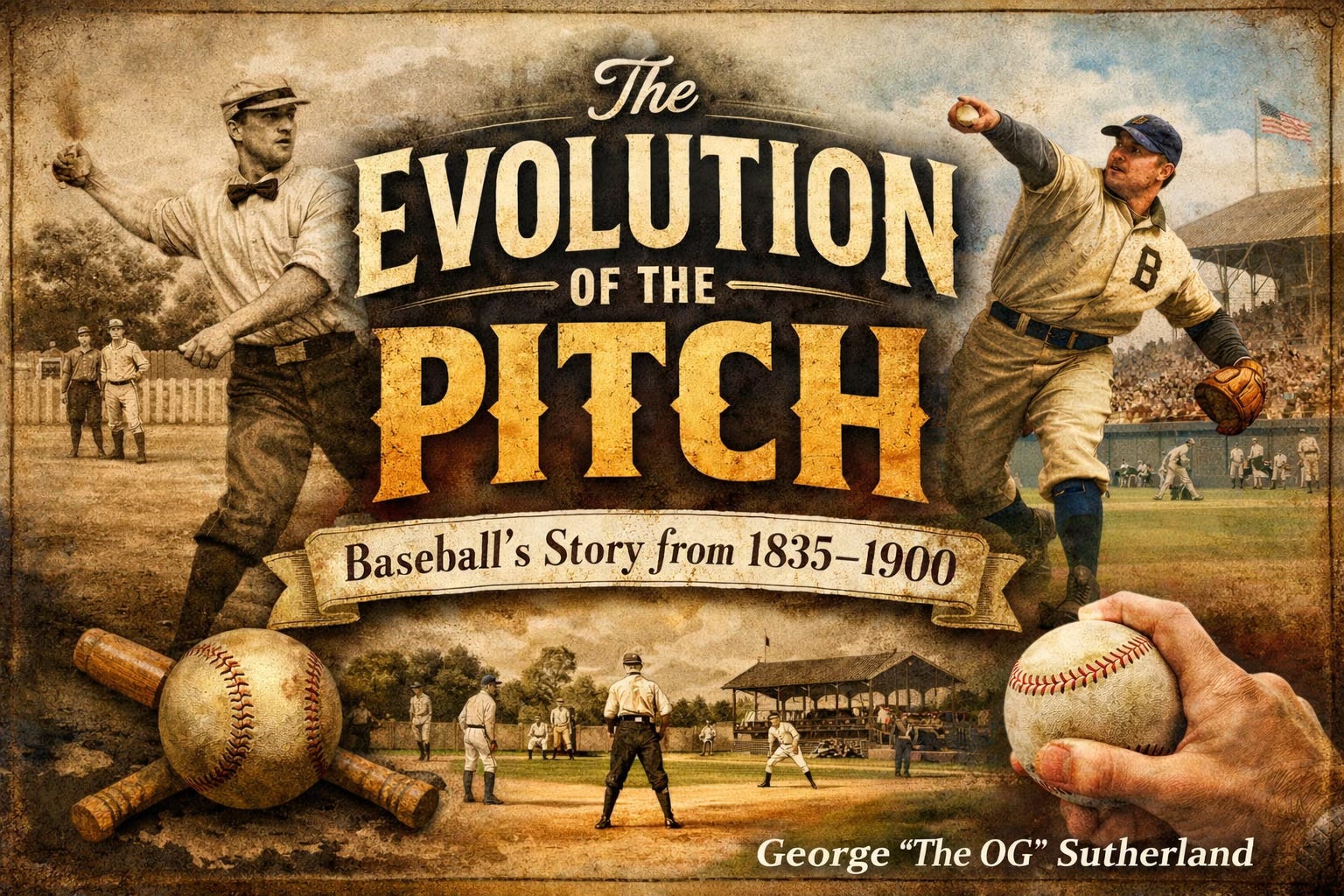
The three greatest loves of my life are, in order, my wife and family, baseball and history. In this series of articles I take a look at the evolution of pitching in baseball from its humble beginnings in the mid 19th century to the technology driven advancements in pitch speed and the spin dynamics of today’s game. My research allowed me to blend baseball and history and provide me with a deeper understanding of the game and the historical evolution of pitching as well as the remarkable art and science of the endeavor.
Nothing is more alluring to the average baseball fan than the home plate umpire saying “play ball” and the next meaningful sound being the sound of a bat hitting a baseball or the snapping sound of a fastball into the mitt of a waiting catcher. This signifies the start of the action and all eyes are on the pitcher as he begins the defensive effort to negate the best efforts of the batter to get on base. The man on the mound is the focus of the opposing team and the fan in the stands. However, this dynamic was not always the case.
This is the first of my three part series.
The Evolution of Baseball Pitching (1835-1900)
Introduction
The evolution of pitching in baseball from 1835 to 1900 represents a fascinating and transformative period in the history of the game. During these developmental years, pitching changed from a rudimentary and mandatory underhand toss, designed to enable hitting, to a more strategic and competitive overhand method of delivery that revolutionized the dynamics of the game. Let’s take a look at the development of the pitching role and the associated rule changes and the basics of pitching mechanics that in their infancy have led to the pitching we see today based on some historical sources I have been able to research.
The Underhand Pitch - (circa 1835–1860)
In the 1830s and 1840s, baseball was still in the infancy stage as an emerging sport. Formal rules eventually came about on or around 1845 by the Knickerbocker Club. The Knickerbocker Rules mandated that pitches be thrown underhand with a “stiff wrist”, resembling a toss in horseshoes, to ensure batters could hit the ball. The pitcher’s role was to deliver a “fair ball” to initiate play, with little emphasis on deception or speed. The pitching distance was roughly 45 feet (about a foot shorter than that of a little league mound) from home plate, and the focus of the game was on hitting and fielding rather than pitching dominance.
This underhand pitch limited the mix of pitches that could be delivered to a batter and the corresponding result was a toss or lob to the batter to give the hitter a “hittable” ball. A process not too unfamiliar to batting practice today. The pitcher was a facilitator to the action, rather than a challenger to the action of hitting a baseball.
Like all sports, the playing styles and advances as well as changes in rules bring the inevitable evolution of the game. As you will see the changes, which were controversial at the time, became commonplace as time passed and eventually became what we witness every time we watch a game.
Transition and Experimentation (1860s–1870s)
By the time the Civil War broke in 1861, baseball was rapidly growing in terms of popularity and fan supported competition. Like all sports, innovation and experimentation became part of the baseball experience. Pitchers who were trying to gain an advantage over a hitter began to experiment with new techniques of delivering a baseball. The Knickerbocker Rules, which were the generally accepted rules of the sport, required the pitch be delivered in an underhand motion. The first attempt to change the delivery of a pitch was the manipulation of the ball’s spin to create movement.
The curveball, whose development is largely credited to Candy Cummings in 1867 was inspired by flipping clam shells across the water. Cummings perfected the motion and the appropriate grip of the ball that resulted in making a ball curve. This development added a level of “deception” to the batter. It still adhered to the rule of underhand delivery but with it’s adoption revolutionized the role of the pitcher. When first implemented by Cummings and others the “change” was met with some disdain as it used deception and was considered “ungentlemanly” in practice by some.
With the formation of the National League in 1876, the pitching distance was standardized at 45 feet. Pitchers were confined to a “pitching box”, generally 4 feet by 5.5 feet in size. There was also the additional requirement for a pitcher to keep both feet on the ground during the delivery of a pitch. This limitation was designed to inhibit a pitcher’s ability to generate arm speed. Much like the introduction of the curve ball, the competitive juices of pitchers eventually resulted in the subtle introduction of delivery changes, like sidearm deliveries and some advanced breaking pitches, beyond the curveball, dubbed “the nickel curve,” thought to be an ancestor of the modern day slider.
Like all eras in the game, there were noted pitching stars during this period. In stark contrast to the modern game, pitchers of this period pitched a rather incredibly high number of innings and made almost double the starts of a modern day pitcher.
Tommy Bond of the Boston Club of the National League pitched 408 innings in 1877. Bond started a lofty 58 games. His efforts netted him a record of 40-17 and an ERA of 2.11. Just two years later, Will White of Cincinnati crushed that feat in 1879 by pitching a mind boggling 680 innings and 75 starts. He compiled a record of 43-31 and an ERA of 1.99.
Prodigious workloads such as these were possible by the nature of underhand pitching. The lower pitch speed/velocity worked together to place much less stress on the pitching arm. As noted above, the motion was like that of tossing a horseshoe or even a bowling ball. Game play was dominated by the facilitation of contact hitting, in contrast to the modern method of trying to strike out the opposing batter. The method of pitch delivery and the focus on contact hitting were a perfect marriage for the game at the time. However, the days of the “soft toss” baseball games would begin to be numbered as the art of pitching was about to undergo some significant changes.
The Overhand Pitch Arrives (1880s)
The decade of the 1880s brought incredible changes in pitching style and rules. The changes which permeated the decade brought about modifications in the rules that eventually resulted in changes to pitch delivery. In 1881, the pitching distance was increased to a new standard of 50 feet for the previous distance of 45 feet. The change took some of the arc out of the delivered pitch and presented a hitter a flatter ball to hit and a newer slight advantage over the pitcher.
In 1883, the then two dominant professional leagues, the National League and the American Association further loosened the historically acceptable pitching delivery motions. This change allowed pitchers to throw a ball at or below shoulder level. This resulted in the increase of speed of a thrown ball to a batter. This change marked the beginnings of making the pitcher a true adversary on the mound, rather than a mere facilitator of the action.
The biggest and final change was the ultimate legalization of the overhand pitch around 1884 by the National League. The next year, in 1885, the rival American Association allowed the pitching delivery style. This was the genesis and real birth of the type of pitching we see at all levels of the game today. The increase in pitch speed and movement has changed the game forever.
As one would anticipate, the newly legalized overhand pitch created an era of pitching dominance, which was nothing less than a revolution for the game. Old Guard heroes like White resisted the change. They noted that there was significant increased arm strain for a pitcher. This fell upon deaf ears and by the mid 1880’s the overhand delivery of a baseball became the universal standard.
It is interesting to note that players going back as far as the 1880’s worried about “arm strain” for a pitcher. As I write this, some 140 years later, the admonition given to the game by the Will White’s of the world in the 1880’s would be a matter of fact and growing concern in baseball today. As this series continues we will see the evolution of pitching science and the resulting problem of arm injuries encountered by pitchers.
The new pitching style also created new pitching stars replacing the Will Whites of the game with newer ones who were now dominant using the overhand delivered baseball. These stars emerged in the late 1880’s. Amos Rusie, known as the “Hoosier Thunderbolt,” demonstrated that the overhand pitch could not only be thrown harder but also could be done so with remarkable control. Tim Keefe brought the pitch to newer heights by showing that he could throw the pitch harder and with even greater control.
As the pitch became more prevalent, newer types of pitches were thrust upon the game. Fastballs, curveballs, and an early versions of the changeup all made their appearance in the game. These changes presented new challenges to hitters and required the batter to adapt quickly as now the pitcher had the “upper hand”.
The late 1880s saw a new generation of younger pitchers like Rusie, Kid Nichols, and Cy Young. They became the recognized stars of the overhand pitch phenomenon. Nichols, whose 15 year career started in 1890 won 361 games with a career 2.95 ERA. The legendary Cy Young, also started his career in 1890. He amassed an incredible 511 wins and a 2.63 ERA over 22 seasons. Years later his exploits led MLB to name the award for best pitcher of every baseball season after Young.
The overhand pitch was here to stay! There would be no going back!
Other Rule Changes and the concept of a Pitching Staff Evolves during this period
The change to the overhand pitching style came with other equally important rule changes that reimagined pitching strategy. In 1887, the rule requiring batters to request high or low pitches was eliminated. This obviously gave pitchers more control over pitch location and the corresponding results. The number of balls required for a walk was standardized at four. Finally, pitchers were allowed to take one step toward the plate during their delivery to the plate, resulting in more velocity of any thrown baseball to a batter.
The “pitching box” was eliminated in 1893. It was replaced with a rubber slab at a now standard 60 feet 6 inches from home plate. This last change was made to equalize or balance offense and defense after the offensive surge caused by overhand pitching at 50 feet. This change was a direct response to the dominance of the overhand pitchers of the late 1880s. Small wonder that today a premium is placed on taller (6’4” to 6’6” and above) pitchers whose elongated delivery or “extension” allows the ball to “explode” on the batter with a closer release point.
Pitching staffs also evolved during this period. In the 1870s, teams relied on a single dominant pitcher, often starting 60+ games and pitching 400–600 innings per season. By the late 1880s, increased game schedules (from 80 to 120+ games) necessitated two or more regular starters, laying the groundwork for modern pitching rotations. For example, the 1890 Boston Nationals experimented with a three-man rotation, a precursor to later rotational strategies. This is in stark contrast to the maximum of 13 pitchers allowed on today’s 26 man roster. This change or evolution will be discussed later in the series.
Pitch Manipulation and Ethical Debates
Pitchers in the 1880s began scuffing, cutting, or applying substances like spit or tar to the ball to enhance movement, practices that were legal until 1920. These techniques, combined with overhand pitching, gave pitchers a significant advantage, contributing to lower batting averages and higher strikeout rates. However, such practices sparked debates about fairness and safety foreshadowing later rules banning ball tampering.
Conclusion
From 1835 to 1900, pitching in baseball evolved from a simple underhand toss to a complex, overhand delivery system that prioritized speed, movement, and strategy. Key rule changes, including the legalization of overhand pitching in 1884–1885 and the adjustment of pitching distances, drove this transformation. Innovations like the curveball and the emergence of dominant pitchers like Amos Rusie, Kid Nichols, and Cy Young redefined the pitcher’s role, making it central to the game’s competitive nature. These changes laid the foundation for modern pitching, influencing the sport’s strategic and cultural development.
Next Up: Part Two: Pitching evolves again in the 20th Century
Fascinating deep dive into how the game evolved. The transition from underhand tosses to overhand pitching fundamentally shifted baseball from a contact-focused sport into the power duel we see today. The whole thing about arm strain warnings from the 1880s being ignored realy echoes todys Tommy John epidemic. I've been fascinated with how sports evolve tactically, and seeing how the pitchers went from facilitators to adversaries changed the entire competitive logic of the game.