


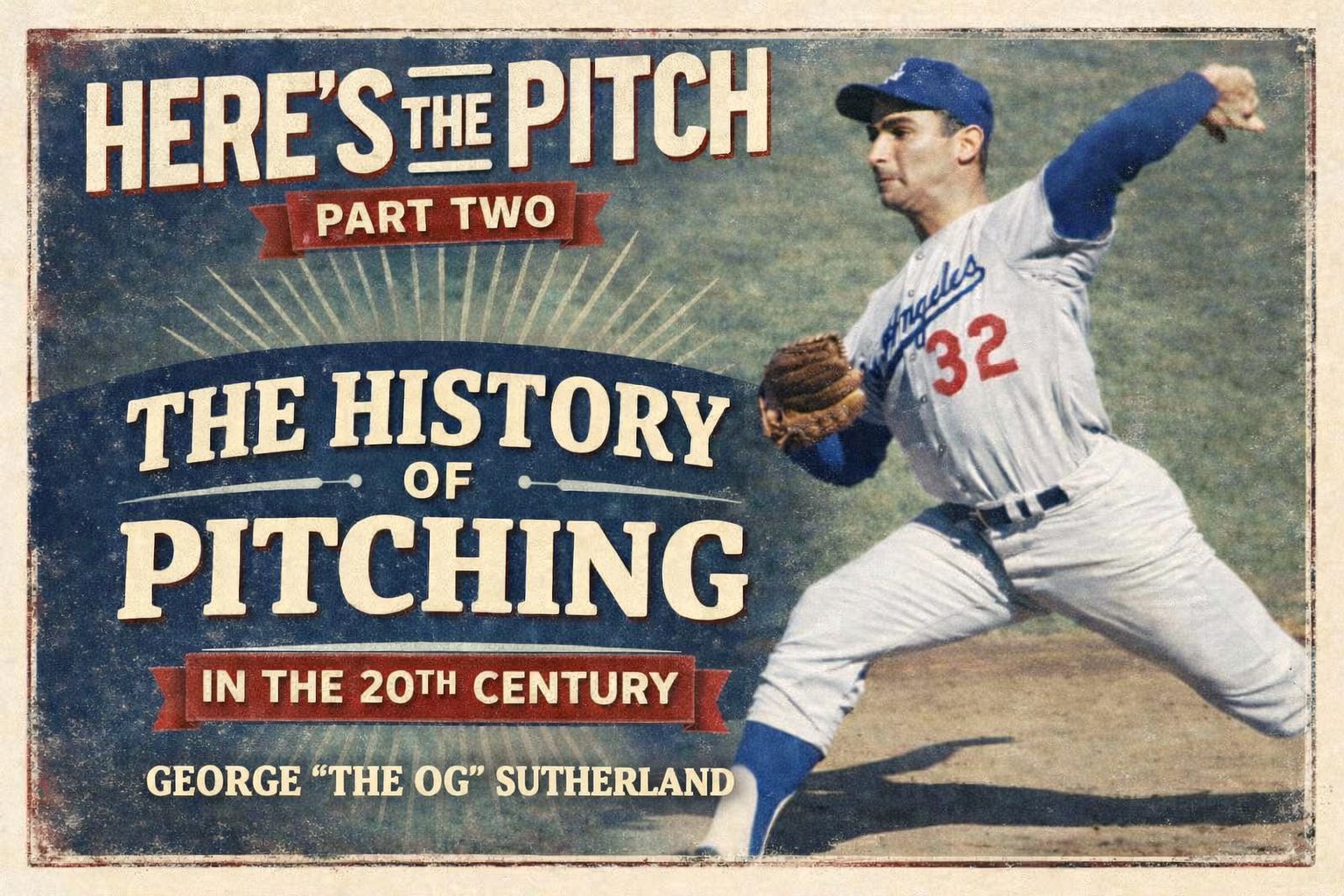
In part two of my series on the evolution of pitching I look at the different “eras” of the 20th century. I will look at the innovations and changes to pitching and the continued metamorphosis in this aspect of the game. I will also note the experience level of injuries for pitchers as the century went on and how medicine and the game dealt with it.
The Evolution of MLB Pitching: The 20th Century (1900-1999)
Introduction
Since the establishment of Major League Baseball (MLB) in the late 19th century, pitching has been the cornerstone of the sport’s strategic and competitive evolution. As noted in part one of this series the introduction of rudimentary fastballs and spitballs of the 1890s revolutionized the game. The intent is to provide an in-depth comparison of MLB pitching for the 20th century. I will look at three different aspects or dimensions of pitching: pitch types, pitcher durability and pitch speed. By looking at historical records and research, my aim is to show how pitching has evolved and its implications for the sport’s past, present, and future.
Pitch Types: From Limited Arsenals to Diverse Repertoires
The Dead-Ball Era (1890–1920)
The Dead-Ball Era is an interesting time in the game. The hallmarks of this period are low scoring games, minimal home run hitting, pitching/defense dominance due to rules allowing pitchers to doctor the baseball (spitball, scuffing), using the same dirty ball for long periods, and spacious ballparks; this fostered strategic “small ball” like bunting, stolen bases, and hit-and-runs, with players judged on speed and bat control, not power, leading to low batting averages.
Games of this era produced scores of 1-0 and 2-1 on a routine basis. There were no restrictions on what a pitcher could do or use on a baseball. This meant that dirt, spit, tobacco juice all could be used to make a baseball move in an unpredictable and erratic motion. The equipment of the day, combined with larger area outfields meant that the average infielder using a smaller glove as compared to today, would play closer and as such outfielders had a lot more territory to cover.
The biggest contributor to the “dead ball era” was the baseball itself. Baseballs of this period had rubber cores and the yarn used to wrap the core was rough and wound in an inconsistent way. The result of hitting one of these balls was a “thud” rather than a sharp crackling sound produced today. The modern baseball is cork centered. The initial version of this baseball was introduced in 1910 and as it was wound a lot tighter produced much more live action when hit. This ball continued to develop over the next 8-10 years.
The crowning jewel in the dead ball era was the fact that baseballs were used until they basically fell apart by beginning to unwind. Foul balls were not kept as souvenirs and were expected to be returned to the field of play. It is estimated that a baseball could be used for upwards of 100 pitches during this era.
Other factors such as the fields of that period were notably rougher than those played on today. Contact hitting, the unlimited use of foreign substances on the ball made it become deformed, darker and as a game went on much harder to see, no less hit. (Remember, there were no such things as batting helmets during the era!)
The end of the “dead ball” came as a result of two major items. The first, fans appreciating the home run exploits of Babe Ruth whose “upper cut” swing became the norm replacing the “swing down” approach. The second was the death of Cleveland shortstop Ray Chapman by a spitball which hit the infielder in the head. The spitball pitch and other forms of “doctoring” were outlawed in 1920. Additional rule changes required that new baseballs be used when older ones got dirty. The end result, hitters could see the ball much easier and allowed them to hit the new “rabbit” ball hard and further.
The simplicity of pitch types during this era arose from several factors. First, the modern concepts of biomechanics was at best in its infancy. This limited the ability to develop more diverse pitches. Second, coaching was basic and much less the specialty that is vital to today’s game. Natural ability and talent were augmented by a high degree of experimentation by individual pitchers. Third, any “book” on a pitcher came as the result of players talking amongst themselves in the dugout or at a tavern while traveling. It was not via an I-Pad full of multi-angle views of the opposing pitcher. Basically, this meant hitters had to be aware of patterns or habits of delivery to help them achieve an advantage and any additional information was delivered via word-of-mouth. In this environment, a three pitch mix was more than adequate to achieve success.
The Dead Ball Fastball
Pitchers like Walter Johnson, who threw primarily fastballs and curveballs, dominated with minimal pitch variety, leveraging speed and movement to generate weak contact. However, the lack of pitch diversity meant most pitchers were vulnerable to hitters who could time their primary offerings, particularly in high-leverage situations.
While on the topic of pitch speed, I tried to determine if there was any concrete evidence of just how fast pitchers of this era threw a baseball. Keep in mind that there were no radar guns. Most of the evidence is anecdotal. There were some attempts to “measure” pitch speed at the time, but these were often “adjusted” due to more detailed reviews using modern physics. Here are some of the modern “estimates” of velocity using current standards and norms. In other words “top speed” is defined as the speed of the ball when it leaves the pitchers hand:
Walter Johnson: Estimated to have thrown in the mid-to-upper 90s mph, possibly touching 100 mph occasionally. One measurement, when adjusted for modern methods, suggests a speed of around 94 mph, and he was universally considered the hardest thrower of his era.
Cy Young: Estimates place his top speed around 94-95 mph, though he reserved maximum effort for “pitching in a pinch” during an era focused on complete games and changing speeds. His nickname “Cyclone” suggests his fastball was exceptionally fast for the time.
Christy Mathewson: He is estimated to have thrown his fastball in the 90-92 mph range. While he had good speed, he was known more for his control and his “fadeaway” (screwball) pitch than for elite velocity like Johnson.
It is important to note that despite the fact that this era had pitching factors that led to unusual movement, there were players like Young, Mathewson and Johnson that could throw with some heat.
Arm Injuries during the Dead Ball Era
Pitching injuries in the Dead Ball Era were common but often not well documented. These included “dead arm” or more plainly put soreness or fatigue primarily brought on by high volume innings, overuse, along with primitive field and mound conditions. Medical treatment for these issues was rare and crude. A “rub some dirt on it” mentality was the mantra of the day promoting toughness over health. Serious injuries ended careers or left a player in chronic pain. The thought of surgery to fix the problem was unheard of and the procedures of today like “Tommy John” were a long way off.
The Transition to the Live-Ball Era (1920–1940)
The banning of the spitball in 1920, following concerns about safety and fairness, marked a significant turning point in pitch development. Pitchers were forced to innovate to replace the movement of doctored pitches. The curveball remained the king of the “movement” pitch. However, the slider emerged in the 1920’s.
While the invention of the pitch is often credited to Hall of Famer Charles Albert “Chief” Bender who threw it in the early 1900s, in the 1920’s it was enhanced or perfected by George Blaeholder, George Uhle and Harry O’Neill. The pitch also had the nickname of “sailing fastball” during this period. The pitch introduced rudimentary pitching mechanics that included variations of grip and release points.
Other pitches began to emerge. The two-seam fastball gained more acceptance during this period. It’s sinking movement or arm-side run provided contrast to the four-seam fastball’s straighter trajectory. Lefty Grove, was a master of getting hitters to ground out consistently. The Changeup began to appear as a basic off-speed pitch, the intent was to disrupt hitter timing. It was not an often used pitch as it was less refined as compared to those seen today. The knuckleball or “flutter ball” was introduced and used occasionally by pitchers like Eddie Cicotte but like today was marked by its difficulty to control.
Arm Injuries of the Live Ball Era
Pitching injuries primarily consisted of chronic arm and shoulder problems. The common thread, like those of the Dead Ball Era, was overuse and fatigue or
”Dead Arm”. Pitchers were expected to throw complete games and often threw over 300 innings a season. The era’s rule changes, which mandated the use of clean, livelier baseballs, also increased the risk of pitchers being struck by batted balls. The lack of knowledge regarding modern biomechanics and workload management were common. Elbow and shoulder strain or worse were very common. Treatment often involved rest, heat therapy, or simply pitching through pain until the arm “gave out”. Pitchers in this era were known for their durability and high pitch counts, but this often came at the cost of career longevity.
The Second Half of the 20th Century (1940–1999)
Pitching arsenals expanded as competition intensified and coaching improved. The slider became a common option for pitchers. Bob Feller and Warren Spahn were considered masters in the beginning of the period and were noted for making the pitch deliver creating a very sharp break. The popularity of the slider was due in large part to it’s combined speed and movement. It was a true complimentary pitch to go along with the curveball and the two and four seam fastball. The changeup evolved into a really sophisticated weapon. It had several variations such as the the circle change which deceived the hitter by projecting the look of a fastball but the ball’s lack of speed produced a noticeable drop in the pitch trajectory. The first to use it to it’s fullest extent was Sandy Koufax, who used the changeup magnificently to keep hitters off balance.
The knuckleball was brought to new prominence with pitchers like Wilbur Wood. The same issues with movement and control continued. Wood was able to master both. The Forkball which is considered the father to the modern Split fingered fastball was introduced as another option in a pitcher’s arsenal. It’s sharp downward motion proved to be effective in the ever changing landscape of pitchers using the art of deception to fool batters.
This period marked a real emphasis on pitch variety reflected a growing, but still vague understanding of biomechanics. Achievements were more often the result of trial and error. Pitch counts and charting were in their infancy.
The game itself changed during this period. The number of teams nearly doubled from 16 in 1940 to the current level of 30 in 1998. Teams moved and were added west of the Mississippi River to make the game truly national, with expansion internationally in Montreal (1968-2004) and Toronto (1976 - Present).
The initial expansion of the early 1960’s allowed more players that were either near or at the end of their careers or were languishing away in the minors due to a lack of available roster openings to play at the MLB level. Quality of play at the plate and on the mound suffered initially.
By 1968, the pitcher had regained the upper hand. Bob Gibson was somewhat credited with being the cause of two significant events prior to the 1969. The first a reduced and tighter strike zone and the second, and more important, the lowering of the pitching mound from 15 to 10 inches. Gibson, in 1968 had a 22-9 record, had 28 complete games during his 35 starts, a 1.12 ERA, a 258 ERA+. a FIP of 1.77, a WHIP of 0.853. Batting averages began to rise after these changes. Yes, 1969 was an expansion year as well!
The construction of pitching staffs underwent significant changes from 1970-1999. Starters went from pitchers who were expected to go the distance to being asked to give six or maybe seven good innings. The game would them be turned over to the bullpen to two new types of pitchers. The setup man who would come in generally in the 7th and 8th innings and the closer, who would finish games in the 9th. The age of pitching specialization was on and there was going to be no looking back.
The badge of honor known as the complete game dropped significantly toward the end of the century. A deep dive into the complete game stat, courtesy of Baseball-Reference.com, shows the steady downward trend experienced from 1970-1999.. In fact the trend shows a decline in complete games (CGs) through that era that actually accelerated as the period went on. The stat shrunk from 1,052 in 1975, to 627 in 1985 and by 1995 that number had shrunk to 275, a drop of 73.8% over those twenty years.
An interesting side note. In 1995 the Red Sox had only seven complete games. The CG leader for the Red Sox was Tim Wakefield with six and Erik Hansen with one.
Arm Injuries in the second half of the 20th Century
The usual suspects of pitching injuries primarily consisting of chronic arm, elbow and shoulder problems continued throughout this period. Overuse and fatigue were still very common. The addition of specialists saw the effect of shorter duration and harder throwing pitchers on the arms of MLB pitchers.
Surgical efforts to repair shoulders were confined to Labrum Repair and Rotator Cuff surgery. These efforts were rudimentary and the results were often mixed at best. There were a few pitchers who underwent these procedures and came back from them with mixed results. Two notable successes were first Orel Hershiser who had labrum reconstruction in 1990. While the general prognosis for such surgery was generally considered career ending, he defied the odds and pitched rather well for an additional 10 years. Second. Roger Clemens had “modern” or arthroscopic rotator cuff surgery in 1985 by the legendary surgeon Dr. James Andrews. He returned to the mound in 1986 and had 24-4 record and won a Cy Young award.
However, the most significant breakthrough came in 1974 and is still used widely and with greater frequency even today.
A Game Changing Solution for Arm Injuries (Tommy John Surgery)
The 20th Century saw incredible advances in medicine. From the X-Ray, Polio Vaccine, antibiotics, organ transplants, insulin for diabetes and chemotherapy for treating cancer, medical breakthroughs led the way to longer lifespans and a much higher quality of living for the human race.
In terms of sports medicine, the most significant advancement came with the 1974 surgery performed on Los Angeles Dodger pitcher Tommy John by orthopedic surgeon and team physician Dr. Frank Jobe. The surgery is an orthopedic procedure to repair or replace a torn ulnar collateral ligament (UCL) in the elbow. The result of the surgery is a stabilization of the joint which was damaged as a result of serious and repetitive throwing motions when pitching a baseball.
At the time the procedure was first performed, it was reportedly given a less than a 1% chance of success. Despite the long odds, the procedure was successful, in fact so much so that John went on to pitch a total of 26 seasons and had three 20-game winning seasons after the surgery, won 164 games and pitched to age 46.
Despite the success of the surgery and the notable results, the surgery was still something of a novelty for the next twenty years with only 12 performed during that time. The number almost doubled from 1995-1999 to 22 MLB players. Recovery from the procedure is generally 12-15 months for pitchers and about 6-8 months for position players. The results of the surgery led to the procedure being named after the player and not the doctor who invented it which is a bit ironic, but such is the world of sports. The procedure would gain much more traction in the 21st century and will be covered in part 3 of this series.
Conclusion
The 20th century also saw a slow but steady rise of strategic pitching, with managers and pitchers focusing on pitch variety and sequencing as well as location to outsmart hitters. Expansion and the addition of an ever diverse collection of talented offensive players led to pitchers needing new ways to gain advantage over hitters.
Specialization became the norm and successful specialists were viewed as valuable members of pitching staffs which were slowly growing in numbers. Fans were starting to become disenchanted with the game after the strike/lockout of the 1994 season. They wanted more from the game and that usually meant offense.
The game obliged with an assault on home run records, and the entrance of steroids and other performance enhancing substances. The end result was that pitching was once again behind hitting. This meant that the art of pitching would be required to morph into the science of pitching to survive and counterbalance the rise in offensive production.
The cat and mouse game of pitcher vs. hitter was about to take a new turn as the 20th century came to a close. Science and technology would come together and give certain advantages to both sides of the battle. That dynamic will be the subject of part three of this series.